Agrifood Has Hundreds of Generative AI Tools. We Mapped Them So You Can Find the Ones That Fit Your Work.

Almost everyone we work with in ag and food has already started with AI: a pilot, a first tool, an assistant added to a product. Now they’re asking what comes next. How do you make what you’ve built better, get it to pay for itself or move toward AI agents (tools that can take steps on their own) without too much cost or risk? Should the next step be bought, built or done with a partner?
I’ve worked on these questions at Bayer Crop Science and Pairwise Plants, and with a growing group of ag and food clients. I’ve seen AI champions try to get started with little budget and no team. I’ve seen teams build something custom and then wonder how to make it better. I’ve seen product teams launch and then try to keep up as generative AI and agents arrive. Few of them looked first at what already existed. Until recently there was little reason to, and no easy place to look.
That has started to change. More AI assets built for agriculture and food appear every month: datasets, models, assistants, connectors and services that a team can pick up rather than build. We think they can get you from pilot to payback faster, and for less, than another custom build. A few months ago that route barely existed. Now both sides are growing: the people looking for help and the tools that could help them. Mostly, they can’t find each other.
The AI Field Guide for Agrifood is built to help them find each other. It starts with the GenAI Directory, a free list of generative AI tools, data and services built for agriculture and food, all available today. Buyers can see what exists before they commit to the next build. Builders can see what’s already out there and show buyers what they offer. Browsing is free. Listing is free. We don’t rank anyone, and the first edition is a starting point, not a complete count.
The first edition lists 903 assets from 578 named publishers, plus many more from individual accounts. Since we closed the first edition, we’ve found 55 more, some new and some we had missed. Here is what the first edition shows.
1. What’s in the GenAI Directory
Agriculture has used AI for years: yield models, weed-spotting cameras, satellite imagery, sprayer vision. The GenAI Directory covers something narrower: tools built on generative AI, the kind of AI that writes, answers questions and creates content. It powers chatbots like ChatGPT, as well as AI agents.
To make the list, an asset has to play a role in a generative AI system or a foundation model (a large AI model trained on huge amounts of data that other tools are built on) and pass four tests: built for agriculture or food, generative rather than conventional analytics, obtainable now and distinct (not a duplicate of another listing). Conventional analytics, computer vision and robotics are out unless they directly feed a generative system. General business software is out too, even if a farm could use it. Every listing links back to where we found it, says what kind of source it is and records when it was last checked. You can read our full method here.
2. A large supply, mostly parts
Put every listing on one chart and the shape is plain. Roughly six in ten are components: datasets, model weights (the trained AI model itself, ready to download), code and test sets. About one in five is a product a person can open and use. About one in thirty is a service you can hire. The rest are custom assistants, prompts and templates.
By layer, the foundation holds 417 assets, close to half of all listings. Delivery, the layer that gets tools into daily use, holds 25. These counts show what is listed, not how much each one is used or worth. A product used on ten thousand farms counts once here, the same as a dataset nobody has downloaded.
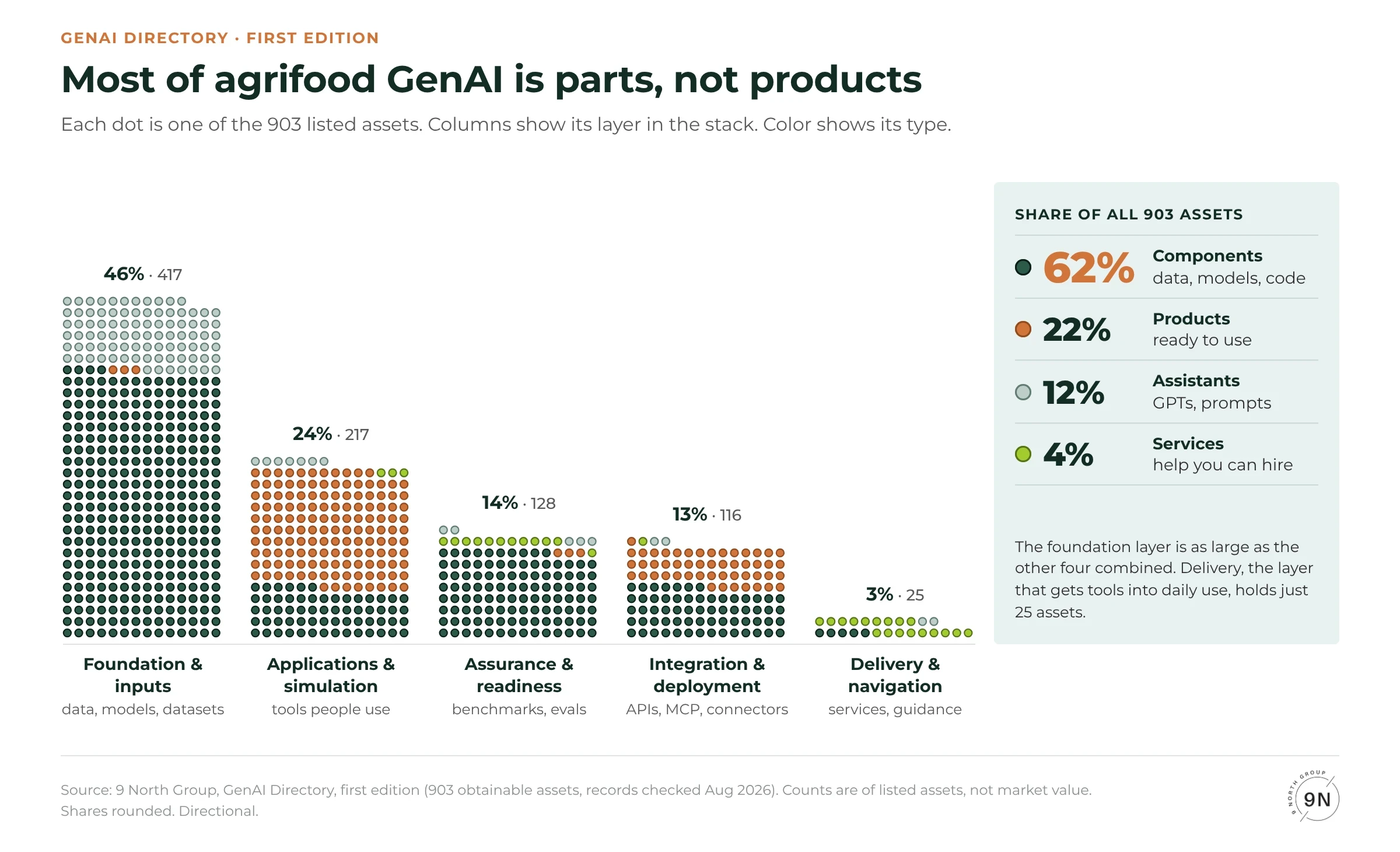
Search for “AI for my plant” or “AI for my farm” and you’ll mostly find tools built for developers and researchers. That’s normal for a young technology. These parts are what finished products get built from. So the better question isn’t “what exists?” It’s “what kind of help exists for my job, and who can put it together for me?”
Supply also bunches up around a few jobs. Three of the ten job families (plan and manage production; research and develop; diagnose, protect and assure) hold about six in ten assets. Plan and manage production alone holds 269, about 30 percent. At the other end, adopt and operate AI, the work of rolling a tool out and running it inside an organization, holds eight.

We’re also testing a simpler question: do people in this industry want to browse and shop for these tools at all? Today they’re scattered across many sites. We want to see what happens when they’re in one place.
3. Agriculture vs. food
Of the assets that clearly serve one side of the value chain, about 530 serve agriculture and about 145 serve food. Roughly another 225, about a quarter of the directory, serve both: data infrastructure, research tools and market tools.
The two sides look like different markets. In agriculture, two-thirds of assets are components, and the main audiences are researchers, builders, and producers and their advisers. In food, components and products are close to even, custom assistants are more common, and 60 percent of assets are built for people running a business. Over half of food assets are hosted by the publisher, and about four in ten must be bought or approved before anyone can use them.
Food companies handle the same paperwork over and over: labels, specifications, supplier documents and audits. They have budgets for it, and vendors have built products to match. Agriculture’s supply is still mostly parts, published in the open by researchers and developers.

4. Where the white space is
Line up the ten job families against the five layers, and the gaps become clear.
Plan and manage production has depth at every layer except delivery. Research and develop is rich in data and in evaluations (tests that check how well an AI tool performs); it holds 70 of the 128 assurance assets in the directory, but offers little a non-technical person could run. Trade, finance and moving goods leans the other way, heavy in applications and integrations, with a single evaluation asset. Comply and govern has no evaluation or delivery assets at all. Delivery is thin in every row but one: build and integrate AI holds about half of the delivery layer, which is where most hireable help sits.
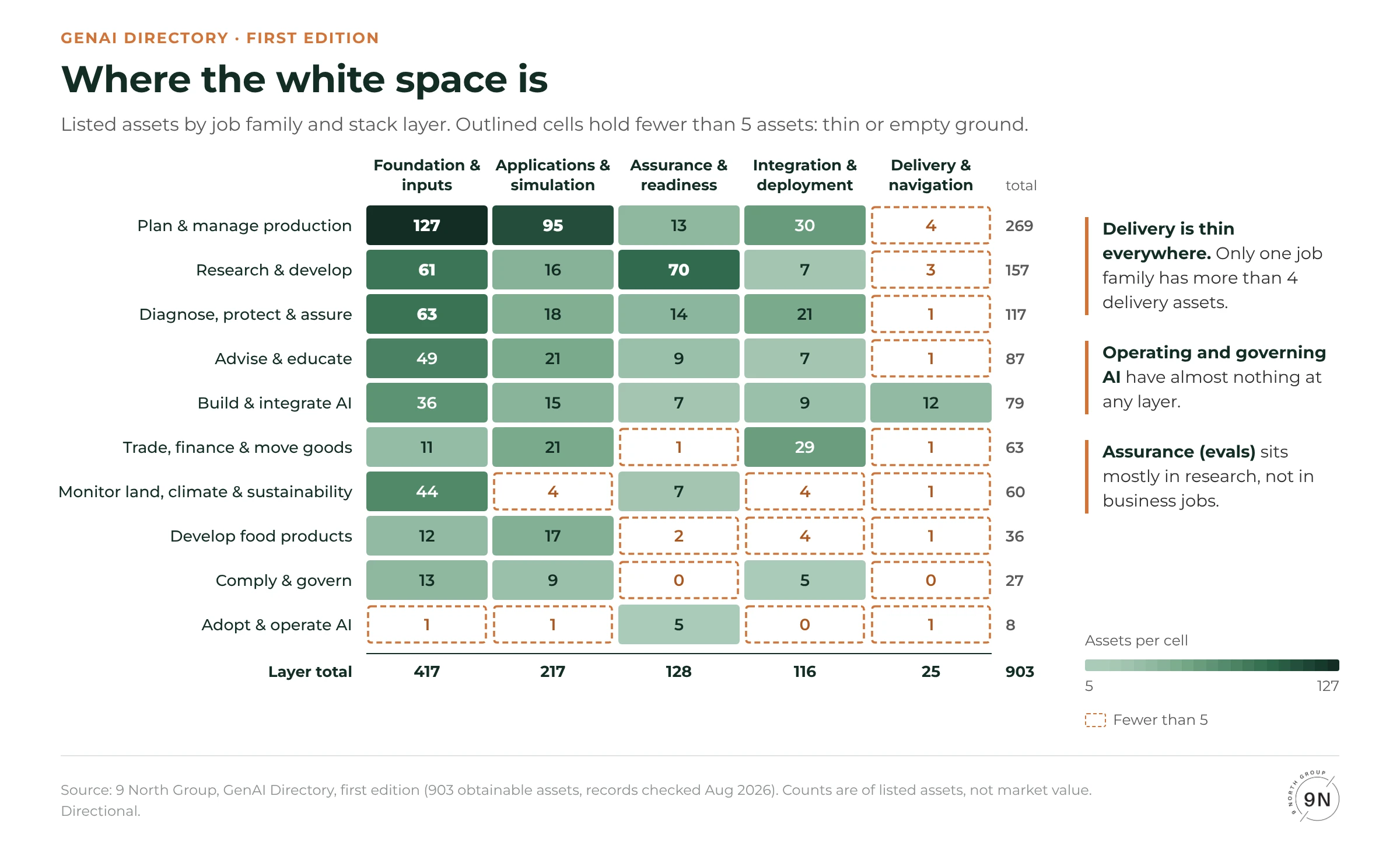
A few areas are starting to take off. Almost everywhere else, there is plenty of room. Where traction exists, it is mostly an assistant layer added to a platform that already holds the data: a market-data service that answers questions in plain language, an order-intake agent inside a distributor’s system, a label checker inside a compliance platform, a financial write-up inside farm accounting software. These are real products that people pay for.
What’s missing is the layer underneath and between them: the tools that test whether an assistant holds up on a specific job, the connectors that move data between the systems a farm or company already runs, the monitoring that keeps a deployed assistant honest over a season. Evaluation built for agrifood business tasks barely exists outside research. For builders, this is where the need is biggest and the competition is smallest. For buyers, it explains why two products that look alike in a demo can act very differently once they’re hooked up to your own records.
The business side of the farm, meaning purchasing, marketing, finance, labor and compliance, has a handful of agrifood-specific assistants. General office tools do most of the rest, and new AI features inside farm software don’t show up as separate listings. Tools for compliance and governance lag furthest behind.
5. Build, buy or partner
Plot each area of work by how many components it has against how many ready-to-use offerings (products, services and assistants). The result gives a rough guide to which route makes sense, based on what is available. Areas above the line have parts but few products. Areas below it have products but few parts.
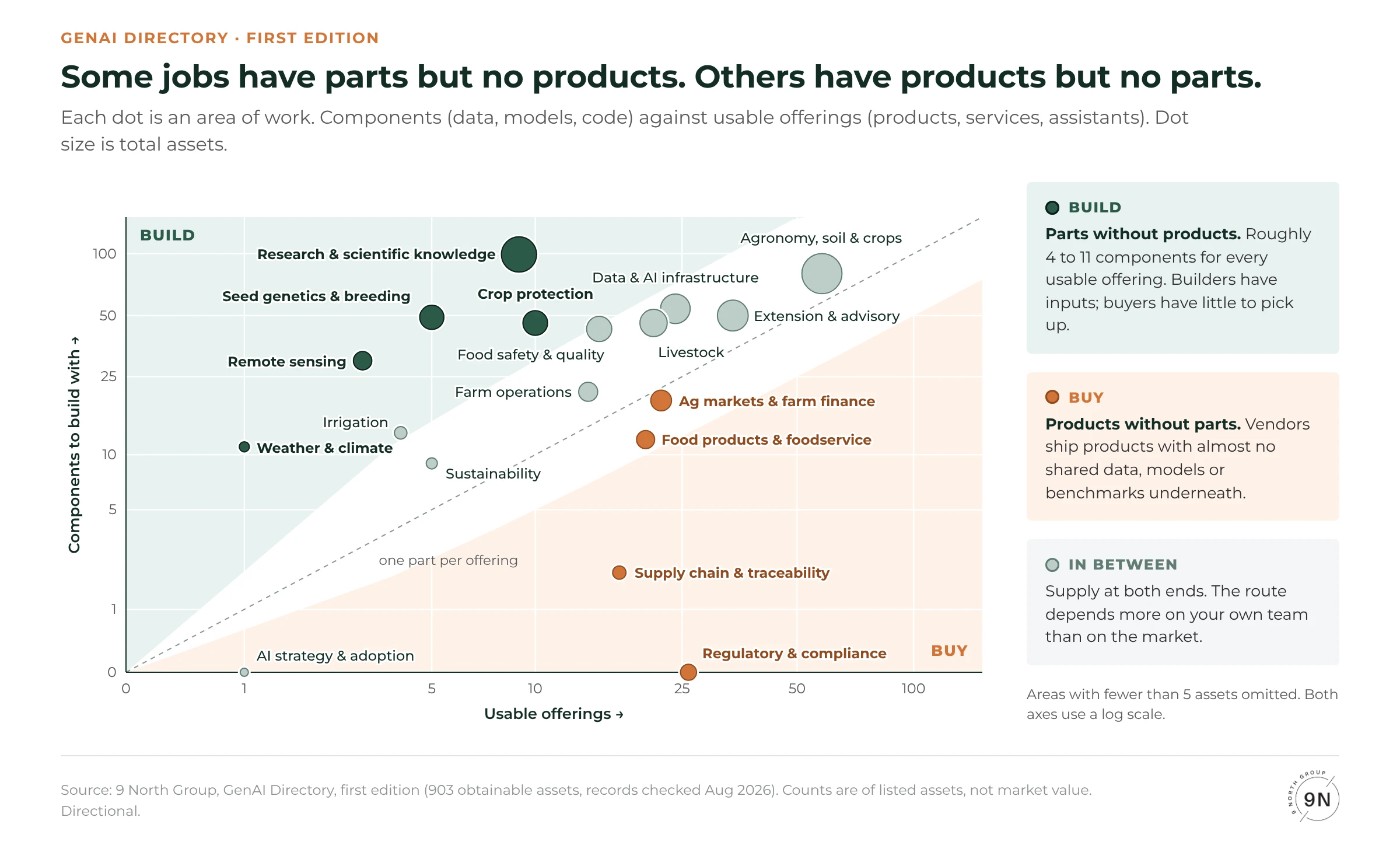
Buy is the live option in supply chain, trade and traceability, and in regulatory compliance, where products far outnumber open parts. Agricultural markets and farm finance, and food products and foodservice, lean the same way. Most of what’s on offer is the assistant layer described earlier, sitting inside market-data services, order systems, compliance and label-review tools, and farm accounting. These are hosted by the vendor, reached through a demo or a sales conversation, and priced for enterprises. Expect to try several, not one, and to ask how each connects to what you already run.
Build is usually the only option in research, seed genetics and breeding, crop protection, remote sensing and weather, where components outnumber usable offerings by roughly four to eleven to one. What’s available is open data, open-weight models (AI models anyone can download and run), test sets and connectors, made for people who build their own systems. A skilled team can move fast here. Without one, you may wait a while for products that don’t exist yet.
Most of the large farm categories sit in between. Agronomy, livestock, food safety, extension and data infrastructure each have a real supply of both parts and products, so the right route depends more on your team than on the market.
Partner is the route where the directory shows the least. Services are about one in thirty listings. In practice the partner is often a platform you already use that is adding generative features, or an operator who assembles parts around your workflow. Connectors (tools that let one system share data with another) make partnering practical. A few come from platform owners, and many more from independent developers. The work of connecting an assistant to your systems and keeping it working has the most room to grow. This is the work we do at 9 North. We build that layer with a company’s own people and technology partners. Some companies do it with their own engineers or a preferred vendor instead, and that works too.
General AI models now score in the mid-to-high nineties on the AI AgriBench test of expert-validated extension questions, and its authors say the test is maxed out. The bar for general knowledge is already high, and any new agronomy assistant has to clear it. But those same authors leave field-level decisions out of the first version of the test, and where general assistants have been tested on specifics, they fail on exactly those: local seed and fertilizer rates, label jurisdictions and season-long field management. The next real test is “what works for my crop, my soil, my label, my season,” and that’s a product and data question, not a general-knowledge one.
Whether you buy, build or partner, the value comes from connecting the tool to your own data and the way you work. Other industries show the same thing: AI does speed up single tasks, but the business sees results only when the work itself is redesigned around the tool.
6. What does “ready” mean?
Ask ten buyers what makes an AI tool ready for their business and you’ll get ten answers. Ask ten builders and you’ll get ten more. Other industries have settled on shared checklists for software security, data handling and service levels. For generative AI and agents in agriculture and food, that conversation is just starting. Nobody has yet agreed what “enterprise-ready” means for an agronomy assistant, a label-review agent or a dataset feeding a breeding model.
To see where things stand, we ran the directory through the checks a buyer might reasonably make, using fields we already record: 373 assets can be used without building anything; 335 have an organization behind them rather than an anonymous account; and 320 aren’t labeled beta, preview or pilot. For 234, the route to get or buy them is clear, and for 219 the terms can be found. Only 36 show use by someone other than the publisher, and 22 of those plug into other systems through an API, a connector or a marketplace.

The steep step near the end measures what gets published, not what works. Evidence of real use is the hardest thing for a buyer to find, partly because publishers haven’t been asked for it in a consistent way. Some of it surely exists and we haven’t found it yet. The open question is which evidence a buyer should expect, in what form and who should vouch for it.
Here is our first attempt at an answer: a plain standard for “ready” that any builder can state the same way, based on evidence, not marketing claims. It has four levels, each adding to the one before:
- Discoverable: a named publisher, a live link and a stated way to get it. Every listing in the directory meets this.
- Trialable: a self-serve trial, demo or sandbox; terms you can find; and a way to plug it in.
- Buyable: a legal entity, a support route and a released version; a pricing model or procurement channel; clear rights over inputs, outputs and training use; a test result on a named agrifood task; and stated languages, with offline use where needed.
- Enterprise-deployable: an independent security audit (such as SOC 2); a real customer deployment that someone outside the publisher can vouch for, with its limits stated; connectors into farm management, business and quality systems; and service levels with monitoring and a human to escalate to.
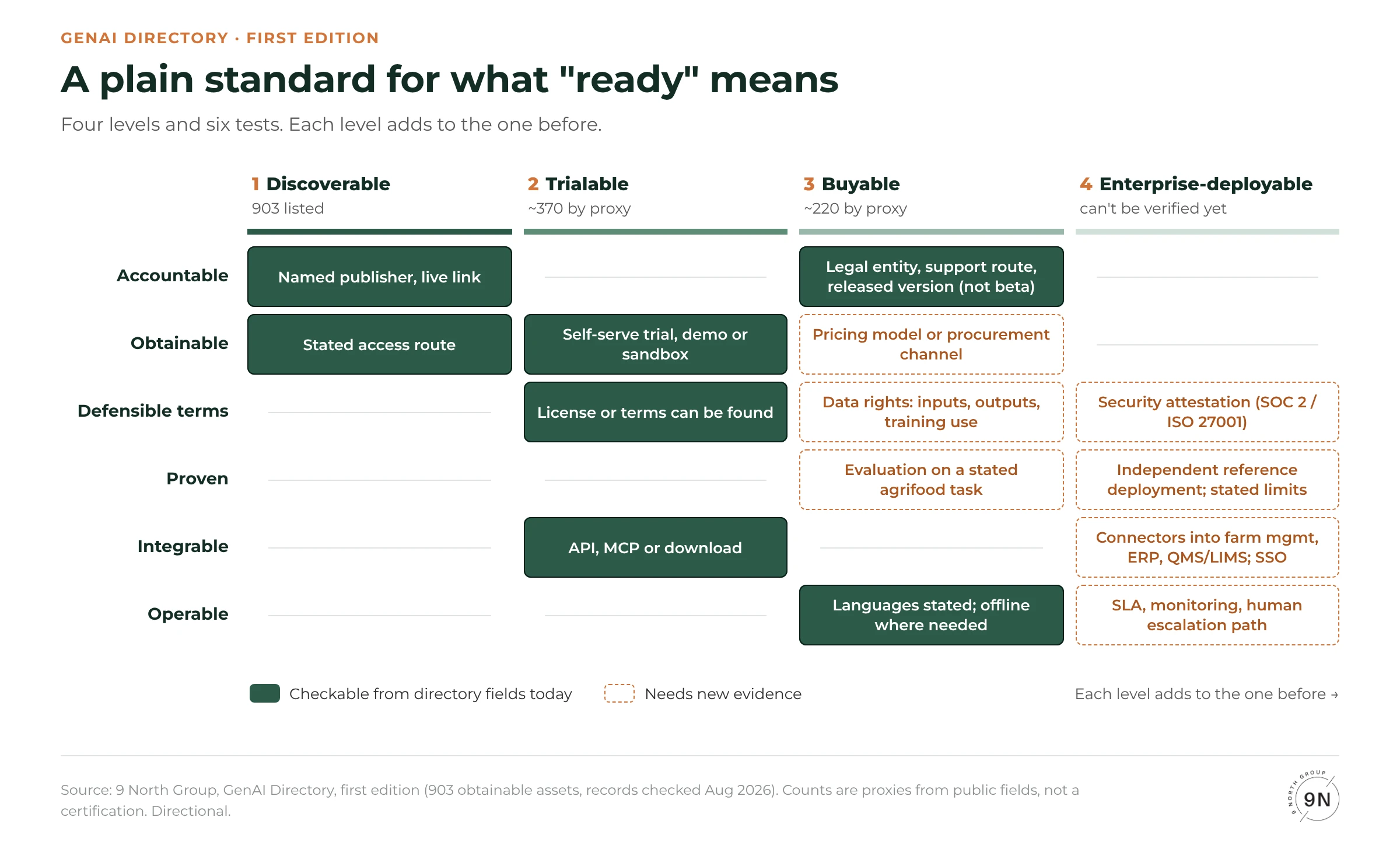
We’re putting this forward as a draft to argue with, not a finished rule. The directory will carry these fields as publishers supply them, and we’ll ask for them. A working solution for a real job is rarely a single listing. It is a chain of data, model, test, connection, application and often a person to set it up. Recording the links between assets is what turns a list into a pathway, and that’s what we’re working on next.
The GenAI Directory is open
Generative AI for agrifood is mostly parts, and the supply is growing fast. Finished products are fewer and cluster where businesses have the same paperwork to do again and again. Many jobs on the farm and in the business have little or nothing yet. Finding an asset is the beginning. Turning it into business value is the work we do with clients. We start with one workflow and the people who run it. We measure how it works today, build a test set from their own cases and compare the options before anyone invests more. When it works, we leave the team running it.
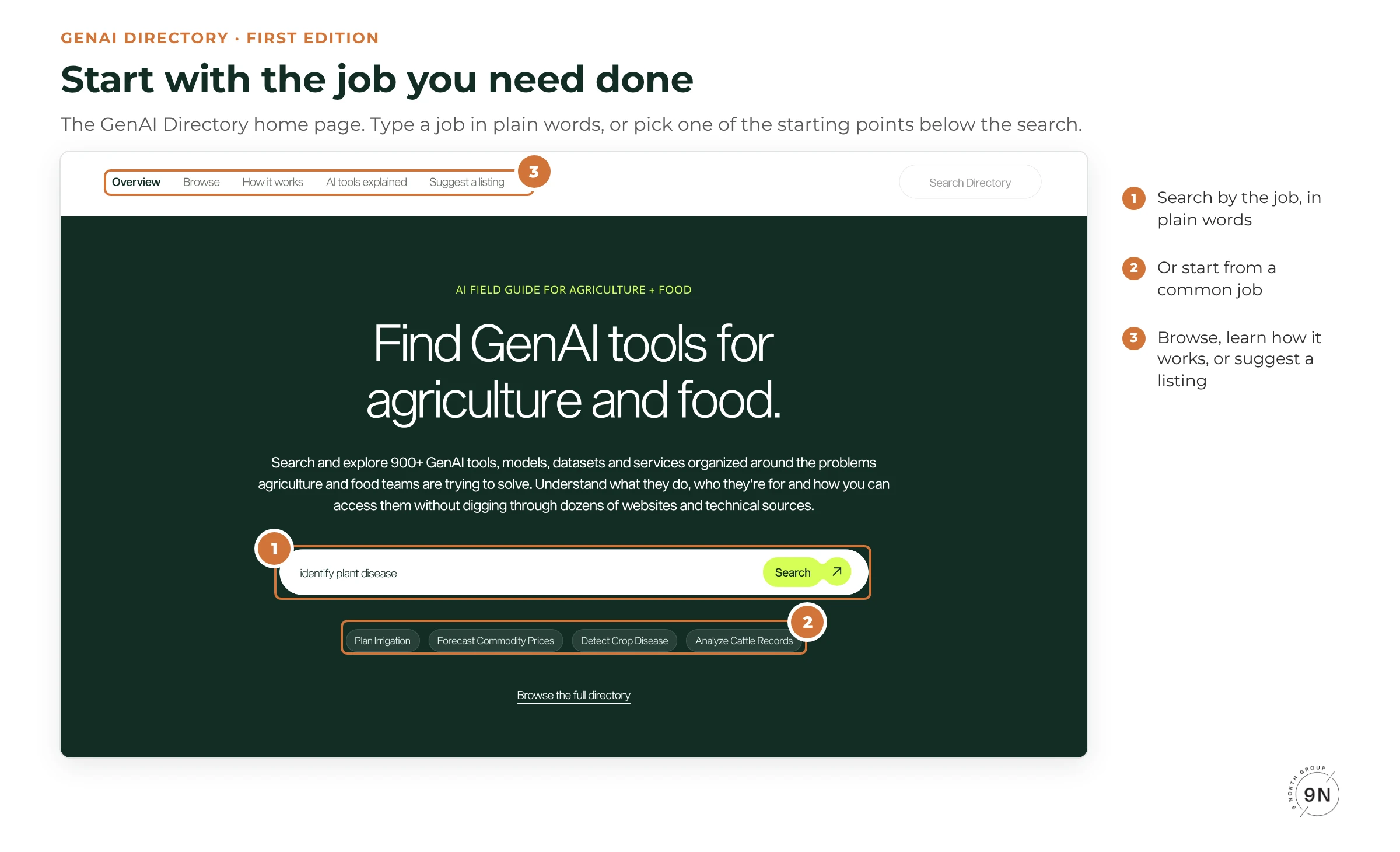
The GenAI Directory for Agrifood is free to browse and free to be listed in. Search by job, by who you are or by the kind of asset you need. Every listing links to its source and says when we last checked it. If something is missing, wrong or shouldn’t be there, tell us; corrections go into the next release. If you’re a publisher, list your asset and state what it connects to, what it needs and who has deployed it. If you’re a buyer, use it to find and compare options for the job you want to solve.
Ready to look? Go ahead and get started.
Explore the GenAI Directory for Agrifood →
Not sure where to start? We offer a free AI readiness assessment →